What Are the Different Types of Wash Basins?
A wash basin is the most-used fixture in most bathrooms, and the type you choose decides far more than its looks. It affects how much floor and counter space you keep, how the plumbing is hidden, which tap you can use and how easy the area is to clean. The right choice depends on your bathroom's size, the space available, the look you want and how the basin will be used every day.
Most wash basin types are defined by how they are installed: on a counter, under it, into it, on the wall or on a stand. Here's a quick overview of the nine main types.
| Wash Basin Type | Best For |
|---|---|
| Countertop / Tabletop Basin | Modern and luxury bathrooms |
| Wall-Mounted Basin | Small and minimalist bathrooms |
| Pedestal Basin | Classic bathroom layouts |
| Semi-Pedestal Basin | Compact bathrooms |
| Under-Counter Basin | Clean, uncluttered vanity designs |
| Semi-Recessed Basin | Narrow countertops |
| Drop-In / Inset Basin | Practical vanity installations |
| Corner Basin | Very small bathrooms |
| Integrated Basin | Seamless, contemporary bathrooms |
9 Types of Wash Basins for Bathrooms
1. Countertop or Tabletop Wash Basin
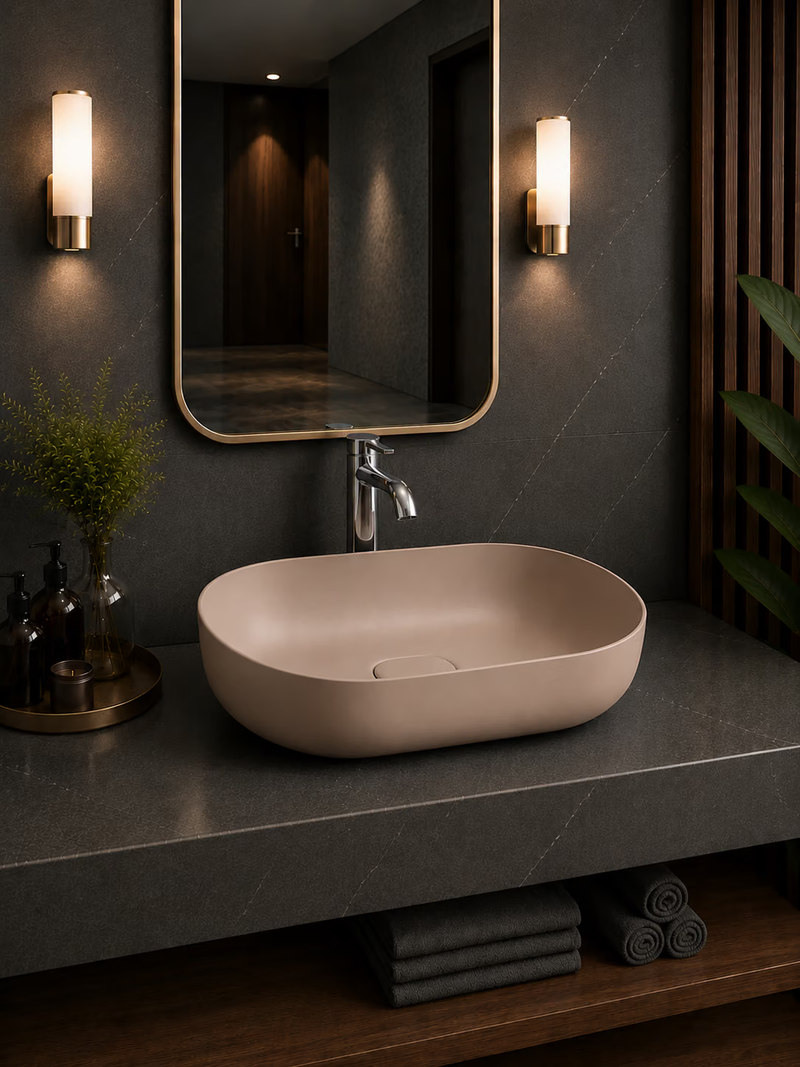
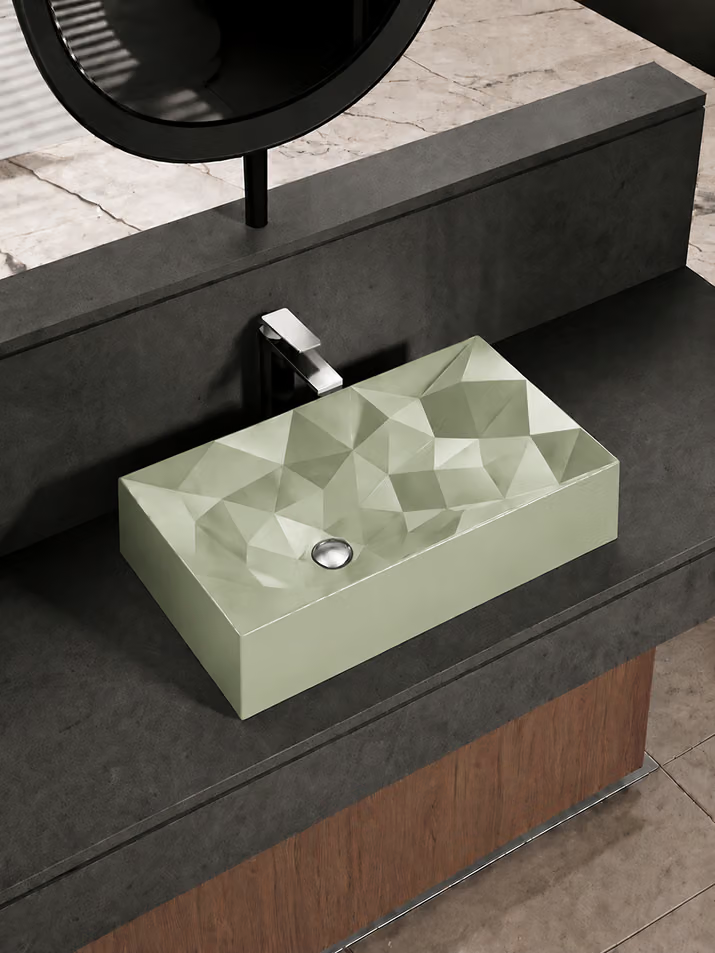
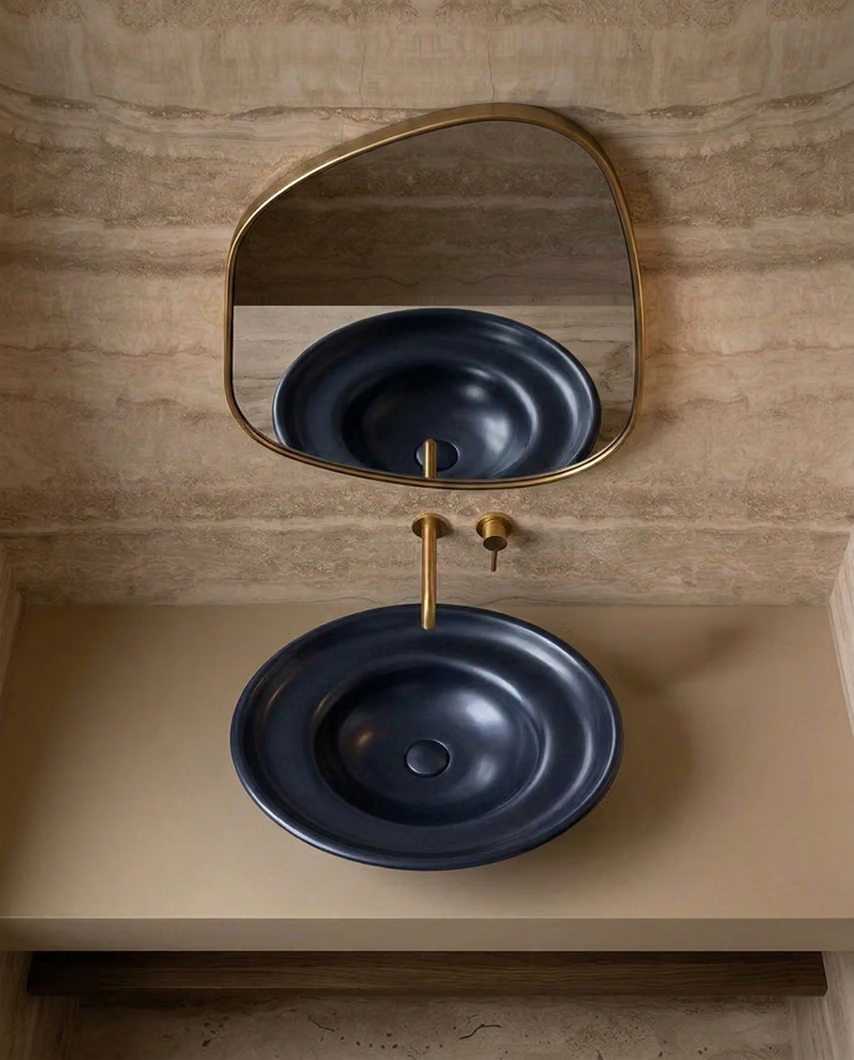
A countertop basin, also called a tabletop basin, sits entirely on top of a vanity, counter or shelf. Only the waste outlet passes through the surface. You'll also hear the term vessel basin; it describes the same above-counter installation, usually for bowl-shaped designs, so it isn't really a separate category.
Because the whole basin is on show, this type offers the widest design choice: round, oval, rectangular, faceted and sculptural shapes in ceramic, quartz, stone and metal. That's why countertop basins are the default in modern and luxury bathrooms. The faceted Kristall basin, made from Sani Quartz, the stainless steel Inox Series and the horseshoe-shaped Shü basin with steel inlays all show how far the format can go.
Limitations: the basin adds height on top of the counter, so the vanity usually needs to be lower than for other types. It also needs a tall basin mixer or a wall-mounted mixer, since a standard deck tap won't reach over the rim.
Works best for: master bathrooms, powder rooms and any vanity where the basin is meant to be the focal point.
2. Wall-Mounted Wash Basin
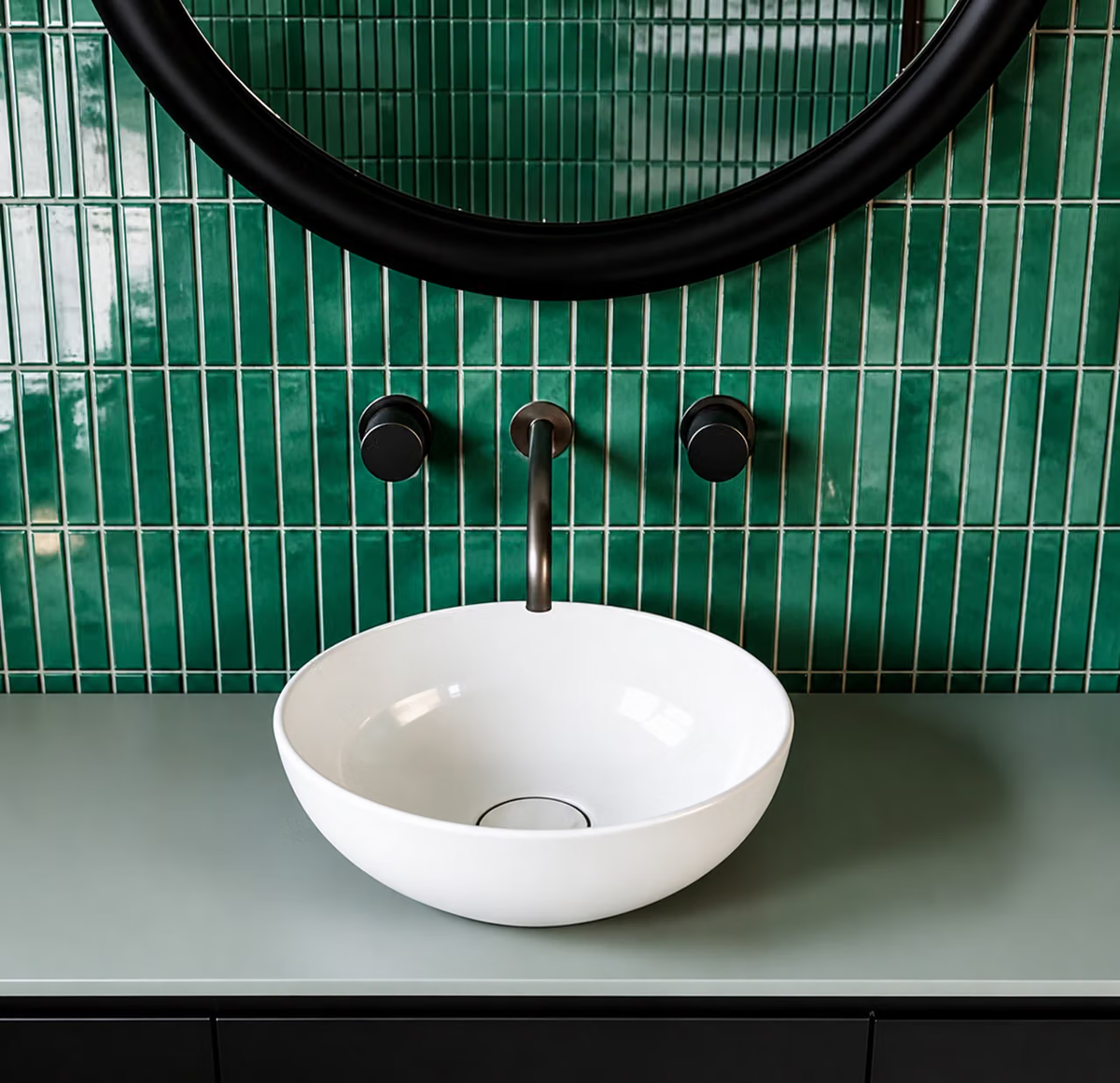
A wall-mounted (or wall-hung) basin is fixed directly to the wall using brackets, bolts or a concealed support frame, with nothing underneath it. Keeping the floor open makes a small bathroom feel larger and makes mopping under the basin much easier, which suits minimalist interiors and compact bathrooms.
Limitations: the wall must be strong enough to carry the basin's weight plus someone leaning on it, so hollow or weak partition walls may need reinforcement. Pipes beneath the basin are visible unless you use a concealed trap or a decorative bottle trap. Storage is limited unless you pair it with a wall-hung vanity.
Works best for: small bathrooms, guest toilets and minimalist designs.
3. Pedestal Wash Basin
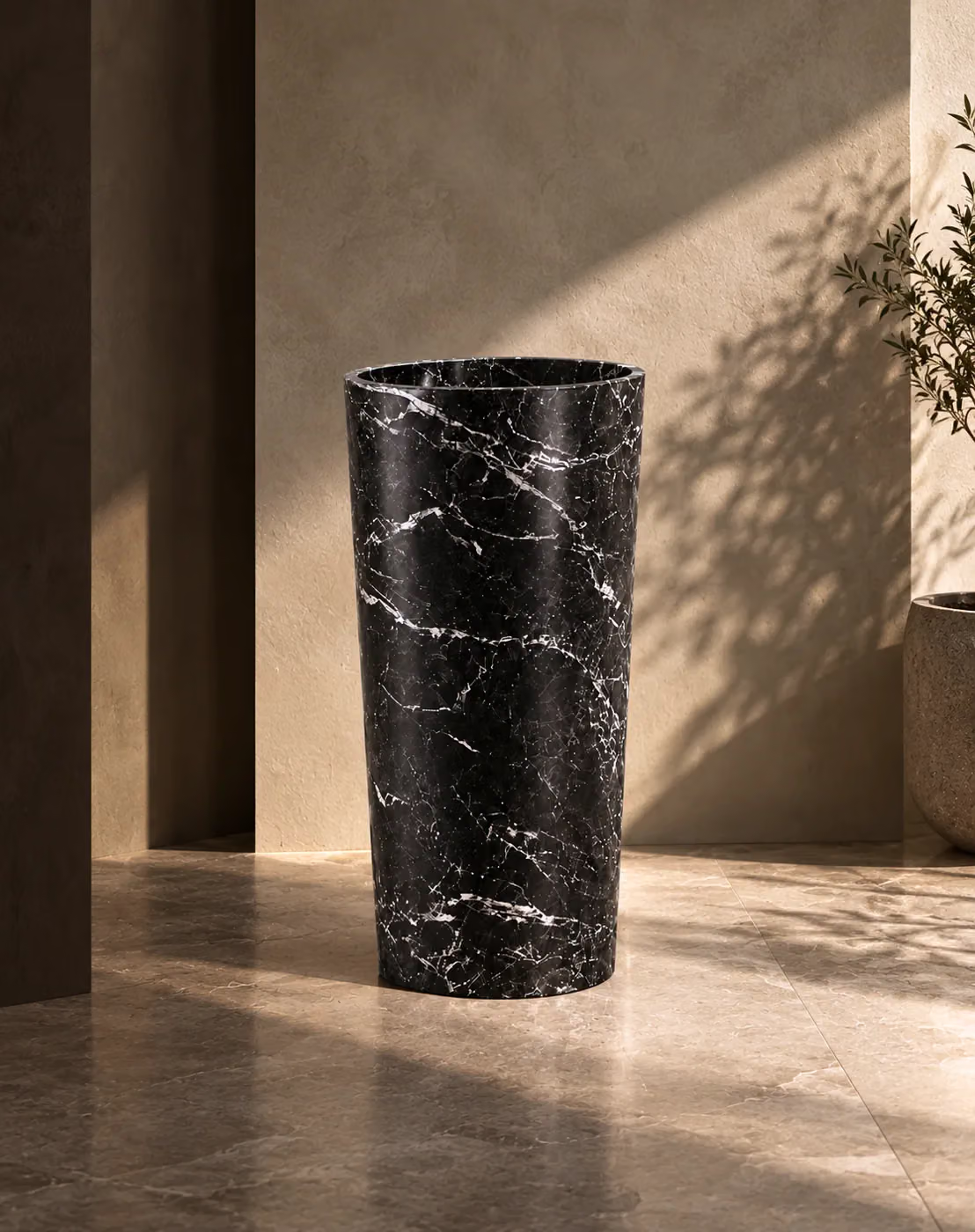
A pedestal basin sits on a full-length column that runs from the basin down to the floor. The pedestal hides most of the plumbing and helps support the basin, and no vanity cabinet is needed. It's a familiar choice in many Indian homes and suits classic or traditional layouts.
The modern evolution of this idea is the freestanding basin, where basin and base are designed as one sculptural piece. Sternhagen's An Ode to Germany collection includes marble freestanding basins such as the Cologne, Dom and Ulm.
Limitations: there's little or no storage or counter space, and the pedestal takes up floor area.
Works best for: classic bathrooms, powder rooms and statement installations where storage is handled elsewhere.
4. Semi-Pedestal Wash Basin
A semi-pedestal basin is wall-mounted but has a short cover (sometimes called a shroud) underneath that hides the trap and pipes without touching the floor. You get the tidy look of a pedestal with the open floor of a wall-mounted basin.
Limitations: like any wall-mounted basin, it needs proper wall support and offers no built-in storage.
Works best for: compact bathrooms where you want the plumbing hidden but the floor kept clear.
5. Under-Counter Wash Basin
An under-counter (or undermount) basin is fixed beneath a cut-out in a solid countertop, so the counter's edge forms the basin's rim. The result is a smooth, uninterrupted vanity surface, and you can wipe water and spills straight into the bowl.
Limitations: it needs a solid, water-resistant countertop such as stone or quartz with a precisely finished cut-out edge. Installation must be accurate, and replacing the basin later usually means working around the countertop. The tap is mounted on the counter or the wall.
Works best for: clean, contemporary vanities and family bathrooms where easy counter cleaning matters.
6. Semi-Recessed Wash Basin
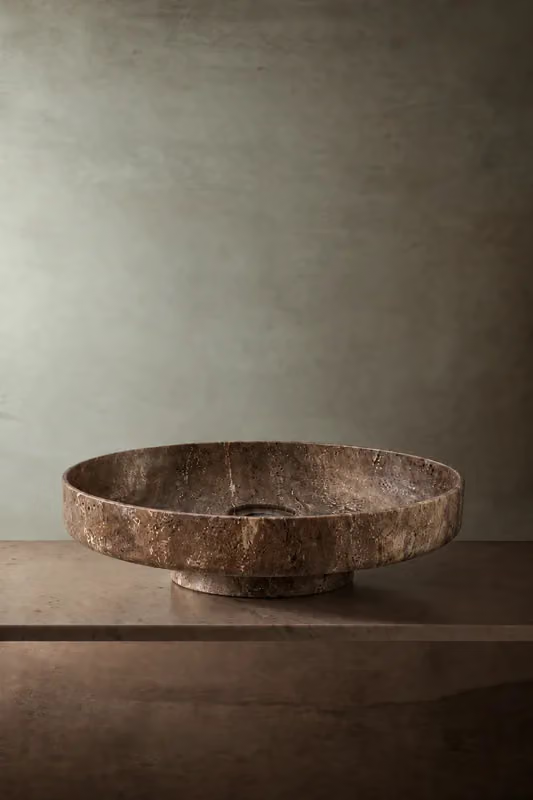
A semi-recessed basin is set partly into the countertop, with the front section projecting beyond the counter's edge. This lets you fit a full-size bowl on a shallow vanity, so the cabinet can be narrower without making the basin too small to use. The Römer basin, a low semi-recessed marble bowl in Silver Travertine or Pietra Grey, is one example.
Limitations: the countertop depth and cut-out must be measured carefully, and the projecting front needs to sit at a comfortable height.
Works best for: narrow bathrooms and shallow vanity cabinets.
7. Drop-In or Inset Wash Basin
A drop-in (or inset) basin is lowered into a cut-out in the countertop, with its rim resting on top of the surface. It's one of the simplest basins to install and replace, works with most counter materials, and comes in many shapes and sizes, which makes it a common choice for practical vanity setups.
Limitations: the visible rim and the joint where it meets the counter collect water and grime, so they need regular cleaning. The look is less streamlined than an under-counter basin.
Works best for: everyday family bathrooms and budget-conscious vanity installations.
8. Corner Wash Basin
A corner basin is shaped to fit into the corner of a room, either wall-mounted or on a small pedestal. It makes use of space that would otherwise go to waste and frees up the main walls.
Limitations: the bowl and the area around it are usually smaller, so there's less room to wash and little space for toiletries. Tap choice can also be more limited.
Works best for: very small bathrooms, guest toilets and powder rooms.
9. Integrated Wash Basin
An integrated basin is formed as part of the countertop itself, so the basin and counter create one continuous surface. It's typically made from solid surface, composite, quartz or ceramic.
With few or no visible joints, there's nowhere for dirt to collect, which makes cleaning simple and gives a sleek, contemporary look.
Limitations: because basin and counter are one piece, damage to either part may mean repairing or replacing the whole unit.
Works best for: seamless modern bathrooms and low-maintenance family bathrooms.
Under-counter vs inset vs integrated: the quick difference. An under-counter basin sits below the counter. An inset basin sits in the counter with its rim resting on top. An integrated basin is part of the counter, with no joint at all.
Which Type of Wash Basin Is Best for Your Bathroom?
| Bathroom Requirement | Basin Types to Consider |
|---|---|
| Small bathroom | Wall-mounted, corner, semi-pedestal |
| Luxury master bathroom | Countertop, integrated, under-counter |
| Modern minimalist bathroom | Wall-mounted, integrated |
| Bathroom with vanity storage | Under-counter, inset, countertop |
| Narrow bathroom | Semi-recessed, compact wall-mounted |
| Guest bathroom / powder room | Countertop, corner, pedestal |
| Easy countertop cleaning | Under-counter, integrated |
Treat these as starting points rather than strict rules. The basin's actual dimensions and your bathroom's layout matter more than the category: a compact countertop basin can work in a small bathroom, and a generous wall-mounted basin can anchor a large one. For powder room ideas, see our guide to powder room design.
Wash Basin Materials and Shapes
Common Wash Basin Materials
- Ceramic / vitreous china: the most widely used material. It's durable, non-porous and easy to clean with mild cleaners, and comes in a huge range of shapes and finishes.
- Natural stone: marble, travertine and similar stones give each basin a unique pattern and a luxurious feel. Stone is heavy and can absorb stains, so it usually needs sealing and pH-neutral cleaners.
- Glass: bright and modern, but shows water spots and fingerprints quickly and needs careful handling to avoid chips.
- Solid surface / composite materials: includes quartz-based materials like Sani Quartz. They allow sharp or seamless forms, have a smooth surface and are generally easy to maintain; minor scratches on some solid surfaces can be repaired.
Metal basins, such as stainless steel, are another option for design-led bathrooms. Our guide to statement metal basins covers them in detail.
Popular Wash Basin Shapes
- Round: soft and compact, good for small vanities.
- Oval: a little longer than round, with comfortable room for washing.
- Rectangular: offers the most usable washing area and suits contemporary bathrooms.
- Square: crisp and architectural, though corners take slightly more effort to clean.
- Asymmetrical / designer shapes: statement forms such as faceted, textured or horseshoe shapes, like the SK Shell and Kristall basins.
Shape affects usable space as well as appearance. A shallow or very curved bowl may look striking but splash more, while a wider, flatter base gives more room to wash.
How to Choose the Right Wash Basin
Bathroom Size and Available Space
Measure the available width and depth, and leave enough clearance in front of the basin to stand and move comfortably, as well as around doors, the WC and the shower.
Installation Type
Check whether the wall can support a wall-mounted basin, whether your countertop suits an under-counter, inset or integrated basin, and where the water supply and drain points are. Also decide how much storage you need, since pedestal and wall-mounted basins offer little without a separate cabinet.
Basin Size and Height
Choose a rim height that's comfortable for everyone in the household. A finished height of around 800–850 mm from the floor is a common guide. For countertop basins, remember to add the basin's own height to the counter. Choose a bowl deep enough to keep splashing to a minimum.
Faucet Compatibility
Match the tap to the basin type:
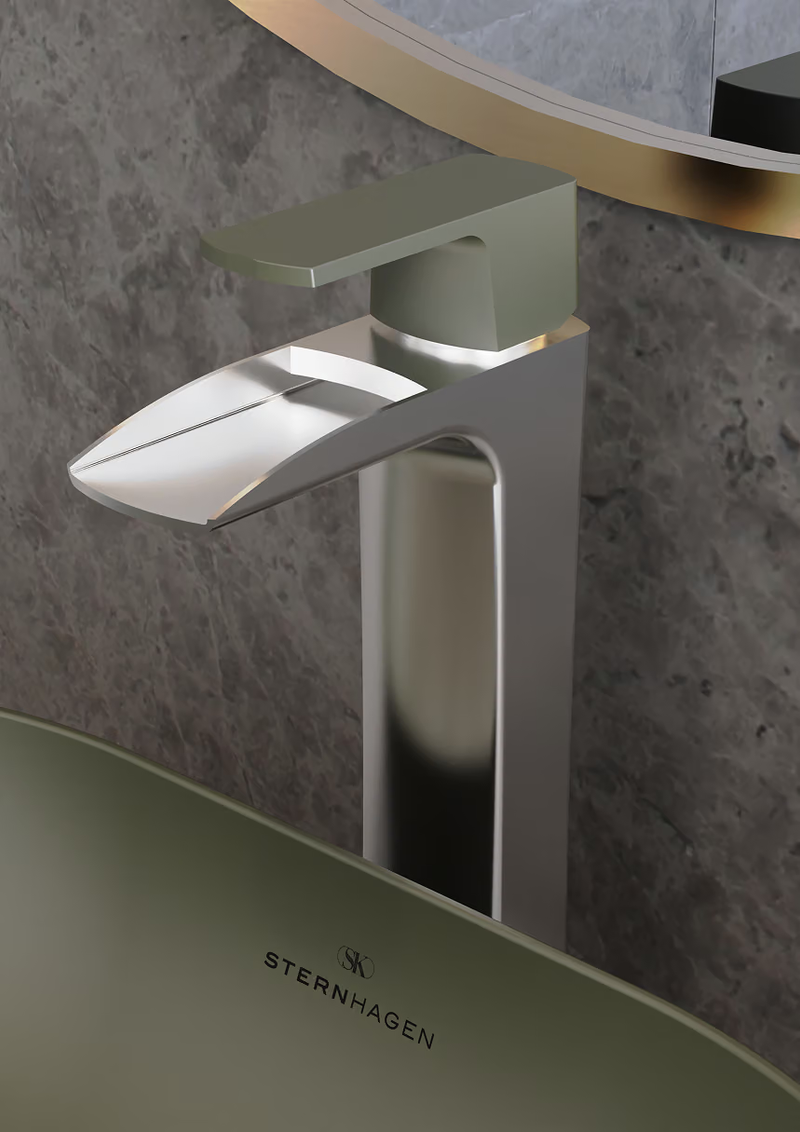
- Countertop basins: a tall basin mixer such as the Danora Tall or Rhine Tall, or a wall-mounted mixer.
- Under-counter, semi-recessed and wall-mounted basins: a wall-mounted basin mixer or a deck-mounted tap where there's counter space.
- Inset, pedestal and integrated basins with a tap hole: a standard deck-mounted mixer such as the Elbe.
Check that the spout reaches the centre of the bowl so water doesn't hit the rim. Browse all basin mixers.
Cleaning and Maintenance
Consider how the surface material behaves with daily use and hard water, and look at exposed rims, joints and corners where grime can collect. Under-counter and integrated basins are the easiest to wipe down; inset rims and tight square corners need more attention. Waste fittings matter too; read what a bottle trap does and why it matters for visible plumbing.
Bathroom Design
Choose a basin that complements the vanity, faucets, mirror and other fixtures. Keeping one finish and design language across the basin, tap and WC makes the bathroom feel planned rather than assembled. For a broader buying checklist, see How to Choose Sanitaryware: 7 Essentials.
Explore Modern Wash Basins from Sternhagen
Sternhagen's wash basin range focuses on countertop, semi-recessed and freestanding designs in materials including Sani Quartz, stainless steel, ceramic and marble. Highlights include the faceted Kristall Suite in shades from black and grey to ice blue and pale gold, the Seerose and Dune basins from the Luxury Bath Suite, designer pieces from Creare by Sussanne Khan, and marble statement basins from An Ode to Germany. Pair them with matching basin mixers and bottle traps, or find a dealer to see them in person.
FAQs
What is the difference between a countertop and a vessel basin?
They describe the same installation: a basin that sits on top of the counter. "Vessel" is usually used for bowl-shaped designs, while "countertop" or "tabletop" covers all shapes.
Which type of wash basin is best for a small bathroom?
Wall-mounted, corner and semi-pedestal basins save the most floor space. A compact semi-recessed basin also works well on a shallow vanity.
Which wash basin is easiest to clean?
Under-counter and integrated basins are easiest, because there's no rim or joint on the counter surface. Wall-mounted basins make the floor below easy to clean.
What is the standard height of a wash basin?
A finished rim height of around 800–850 mm from the floor is a common guide, but adjust it to suit the people using the bathroom. For countertop basins, include the basin's own height when planning the counter.